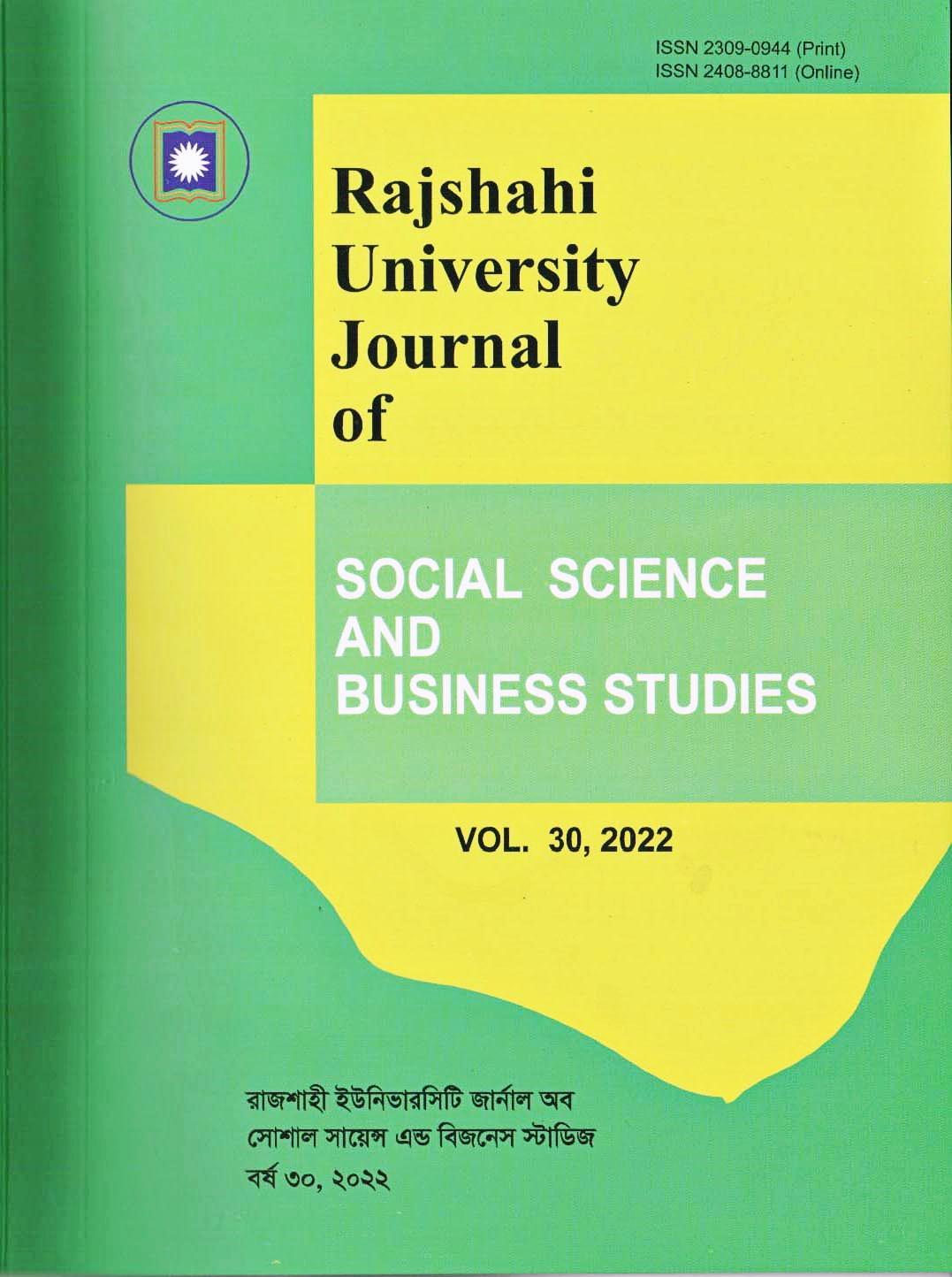
Effect of Environmental Accounting and Reporting on Financial Performance: Evidence from DSE Listed Fuel and Power Sector Companies
DOI:
https://doi.org/10.64102/rujssbs.0476Keywords:
Environmental accounting, environmental reporting, environmental sustainability, climate change, mitigation approachesAbstract
Globally, Bangladesh is considered one of the most climate-vulnerable countries. Subsequently, this study aimed to find out how environmental accounting and reporting (EAR) is performed by the 23 companies listed on the Dhaka Stock Exchange (DSE) in the fuel and power sector. Additionally, the study assessed the association between the performance of the Environmental Accounting and Reporting Practices Index for Fuel and Power Industry (EARPIFPI) and selected financial performance indicators. The authors developed a self-constructed index, EARPIFPI, to measure the degree of EAR practices of the companies. The findings of the study indicate that the performance of EAR practices is abysmal and disappointing, ranging from 0 to 38 (according to pre-developed index items). Out of twenty three companies, seven companies reported no issues regarding EAR practices, indicating an inclination to achieve lower disclosures and reporting practices. Of the fifteen companies reported four had less than five index items, three from five to ten and six with eleven to twenty while two exceeded thirty. The variety of reporting practices and settings highlights the need for a mandatory regularity framework in Bangladesh. In addition, EAR is also found to have a statistically significant effect on financial performance measure such as net profit after tax (NPAT), earnings per share (EPS), net assets par value share (NAVP), return on equity (ROE) and return on assets (ROA). The study will eventually help the government of Bangladesh to promulgate regulations for companies against EAR practices related to climate change, environmental protection and environmental sustainability.
Downloads
References
Abdel Jaleel, F. V., & Ousama, A. A. (2016). The relationships between environmental risk, environmental disclosure, and firm performance. Environmental Disclosure, and Firm Performance (August 1, 2016). https://dx.doi.org/10.2139/ssrn.3734497
Afiukwa, C. A., Igwe, D. O., & Ubi, B. E. (2021). Biotechnology role in climate change adaptation and mitigation for sustainable crop production. In Handbook of Climate Change Management: Research, Leadership, Transformation (pp. 167-193). Cham: Springer International Publishing.
Ahmad, B., Hossain, M. A., Uddin, M. M., & Sultana, Z. (2025). Environmental Accounting Practices and Corporate Governance: A Bibliometric Analysis of Global Trends and Research. The cost and Management, 53(4), 4-26
Akther, T. (2017). Corporate environmental reporting and profitability: A study on listed companies in Bangladesh. Jagannath University Journal of Business Studies, 5(1), 99-104.
Alsaifi, K., Elnahass, M., & Salama, A. (2020). Carbon disclosure and financial performance: UK environmental policy. Business Strategy and the Environment, 29(2), 711-726. https://doi.org/10.1002/bse.2426
Amahalu, N. (2020). Effect of environmental cost disclosure on profitability of listed oil and gas firms in Nigeria. International Journal of Academic Research in Accounting, Finance and Management Sciences, 10(2), 157-170. https://ssrn.com/abstract=3704487
Bebbington, J. (1997). Engagement, education and sustainability: a review essay on environmental accounting. Accounting, Auditing & Accountability Journal, 10(3), 365-381. https://doi.org/10.1108/09513579710178115
Bose, S., Khan, H. Z., Rashid, A., & Islam, S. (2018). What drives green banking disclosure? An institutional and corporate governance perspective. Asia Pacific Journal of Management, 35(2), 501-527.https://doi.org/10.1007/s10490-017-9528-x
Burton, A. L. (2021). OLS (Linear) regression. The encyclopedia of research methods in criminology and Criminal Justice, 2, 509-514
Chan, J. C. H., & Welford, R. (2005). Assessing corporate environmental risk in China: an evaluation of reporting activities of Hong Kong listed enterprises. Corporate Social Responsibility and Environmental Management, 12(2), 88-104. https://doi.org/10.1002/csr.88
Chelli, M., Durocher, S., & Fortin, A. (2018). Normativity in environmental reporting: A comparison of three regimes. Journal of Business Ethics, 149(2), 285-311.https://doi.org/10.1007/s10551-016-3128-4
Cimboláková, I., Uher, I., Laktičová, K. V., Vargová, M., Kimáková, T., & Papajová, I. (2019). Heavy metals and the environment. In Environmental factors affecting human health. IntechOpen. 10.5772/intechopen.86876
Climate Risk and Adaptation in the Electric Power Sectors (CRAEPS-ADB, 2012) https://www.adb.org/ sites/default/files/publication/29889/climate-risks-adaptation-power-sector.pdf
Data, I. Q., & Silverman, D. (2011). A guide to the principles of qualitative research. Sage Publications, London.
De Silva Lokuwaduge, C., & De Silva, K. (2020). Emerging corporate disclosure of environmental social and governance (ESG) risks: An Australian study. Australasian Accounting, Business and Finance Journal, 14(2), 35-50.http://dx.doi.org/10.14453/aabfj.v14i2.4
Deswanto, R. B., & Siregar, S. V. (2018). The associations between environmental disclosures with financial performance, environmental performance, and firm value. Social responsibility journal, 14(1), 180-193.https://doi.org/10.1108/SRJ-01-2017-0005
Dobler, M., Lajili, K., & Zéghal, D. (2014). Environmental performance, environmental risk and risk management. Business Strategy and the Environment, 23(1), 1-17.
Environmental and Social Risk Briefing for Power Generation (ESRBPG, 2015) https://www.banktrack.org/ download/160620_power_generation_guidance_note_pdf
Gerged, A. M., Beddewela, E., & Cowton, C. J. (2021). Is corporate environmental disclosure associated with firm value? A multicountry study of Gulf Cooperation Council firms. Business Strategy and the Environment, 30(1), 185-203. https://doi.org/10.1002/bse.2616
Gray, R., & Milne, M. (2002). Sustainability reporting: who's kidding whom?. Chartered Accountants Journal of New Zealand, 81(6), 66-70.
Haninun, H., Lindrianasari, L., & Denziana, A. (2018). The effect of environmental performance and disclosure on financial performance. International Journal of Trade and Global Markets, 11(1-2), 138-148.http://www.inderscience.com/jhome.php?jcode=ijtgm
Hassan, O. A., & Romilly, P. (2018). Relations between corporate economic performance, environmental disclosure and greenhouse gas emissions: New insights. Business strategy and the environment, 27(7), 893-909.https://doi.org/10.1002/bse.2040
Holland, L., & Foo, Y. B. (2003). Differences in environmental reporting practices in the UK and the US: the legal and regulatory context. The British Accounting Review, 35(1), 1-18.https://doi.org/10.1016/S0890-8389(02)00127-0
Homan, H. S. (2016). Environmental accounting roles in improving the environmental performance and financial performance of the company. South East Asia J Contemp Bus Econ Law, 11, 9-15.
Hossain, M. S., Uddin, M. J., & Fakhruddin, A. N. M. (2013). Impacts of shrimp farming on the coastal environment of Bangladesh and approach for management. Reviews in Environmental Science and Bio/Technology, 12(3), 313-332. https://doi.org/10.1007/s11157-013-9311-5
Hossain, M., Islam, K., & Andrew, J. (2006). Corporate social and environmental disclosure in developing countries: Evidence from Bangladesh. https://hdl.handle.net/10779/uow.27800553
Islam, M. J., Roy, S. K., Miah, M., & Das, S. K. (2020). A review on corporate environmental reporting (CER): An emerging issue in the corporate world. Canadian Journal of Business and Information Studies, 2(3), 45-53.
Islam, Md Jamsedul. "Sustainability reporting of banking companies in Bangladesh: a study on environmental aspect." Canadian Journal of Business and Information Studies 2, no. 2 (2020): 35-44.
Islam, R., Uddin, M. M., Khan, M. S., & Islam, A. (2025). Corporate Carbon Accounting Practices in Bangladesh: Current Practices, Gaps and Policy Implications. Journal of Environmental Science and Economics, 4(2), 1–17. https://doi.org/10.56556/jescae.v4i2.1335
ISO and Energy (ISO-Energy, 2018) https://www.iso.org/files/live/sites/isoorg/files/store/en/ PUB100320.pdf
Kilincarslan, E., Elmagrhi, M. H., & Li, Z. (2020). Impact of governance structures on environmental disclosures in the Middle East and Africa. Corporate Governance: The international journal of business in society, 20(4), 739-763.
Kouloukoui, D., Sant'Anna, Â. M. O., da Silva Gomes, S. M., de Oliveira Marinho, M. M., de Jong, P., Kiperstok, A., & Torres, E. A. (2019). Factors influencing the level of environmental disclosures in sustainability reports: Case of climate risk disclosure by Brazilian companies. Corporate Social Responsibility and Environmental Management, 26(4), 791-804.https://doi.org/10.1002/csr.1721
Lu, L. W., & Taylor, M. E. (2018). A study of the relationships among environmental performance, environmental disclosure, and financial performance. Asian Review of Accounting, 26(1), 107-130. https://doi.org/10.1108/ARA-01-2016-0010
Madein, A. (2020). The institution of environmental reporting in Japan: an exploratory study. Asian-Pacific Management Accounting Journal, 15(3), 189-218. https://doi.org/ 10.24191/APMAJ.v15i3-08
Malarvizhi, P., & Matta, R. (2016). Link between corporate environmental disclosure and firm performance–perception or reality?. The British Accounting Review, 36(1), 107-117.
Masud, M. A. K., Bae, S. M., & Kim, J. D. (2017). Analysis of environmental accounting and reporting practices of listed banking companies in Bangladesh. Sustainability, 9(10), 1717.https://doi.org/10.3390/su9101717
Masuma, M. H., Hassanb, N., & Jahana, T. (2019). Corporate climate change reporting: Evidence from Bangladesh. Accounting and Management Information Systems, 18(3), 399-416.http://dx.doi.org/10.24818/jamis.2019.03005
Nowiski, N. (2018). Rising above the storm: Climate risk disclosure and its current and future relevance to the energy sector. Energy LJ, 39, 1.
Nuskiya, M. N. F., Ekanayake, A., Beddewela, E., & Meftah Gerged, A. (2021). Determinants of corporate environmental disclosures in Sri Lanka: the role of corporate governance. Journal of Accounting in Emerging Economies, 11(3), 367-394. https://doi.org/10.1108/JAEE-02-2020-0028
Okafor, N. (2018). Oil companies performance and environmental accounting reporting in Nigeria. Asian Journal of Economics, Business and Accounting.Paolone, F., Granà, F., Martiniello, L., & Tiscini, R. (2021). Environmental risk indicators disclosure and value
Paolone, F., Granà, F., Martiniello, L., & Tiscini, R. (2021). Environmental risk indicators disclosure and value relevance: An empirical analysis of Italian listed companies after the implementation of the Legislative Decree 254/2016. Corporate Social Responsibility and Environmental Management, 28(5), 1471-1482. https://doi.org/10.1002/csr.2181
Pedron, A. P. B., Macagnan, C. B., Simon, D. S., & Vancin, D. F. (2021). Environmental disclosure effects on returns and market value. Environment, Development and Sustainability, 23(3), 4614-4633. https://doi.org/10.1007/s10668-020-00790-2
Rahaman, M., & Esraz-Ul-Zannat, M. (2021). Evaluating the impacts of major cyclonic catastrophes in coastal Bangladesh using geospatial techniques. SN Applied Sciences, 3(8), 727. https://doi.org/10.1007/s42452-021-04700-7
Rashid, M. M., Uddin, M. M., Islam , R., & Kayser, M. J. (2025). Current State of Human Development and Human Capital Reporting Practices in Bangladesh towards Sustainability. Global Sustainability Research, 4(2), 113–132. https://doi.org/10.56556/gssr.v4i2.1334
Sarkar, S. H., & Ahmed, R. (2020). Corporate environmental accounting disclosure in Bangladesh. International Journal of Applied Business and Economic Research, 18(1), 39-53.
Sinclair-Desgagne, B., & Gozlan, E. (2003). A theory of environmental risk disclosure. Journal of environmental Economics and Management, 45(2), 377-393.https://doi.org/10.1016/S0095-0696(02)00056-6
Singh, H., Bhardwaj, N., Arya, S. K., & Khatri, M. (2020). Environmental impacts of oil spills and their remediation by magnetic nanomaterials. Environmental nanotechnology, monitoring & management, 14, 100305. https://doi.org/10.1016/j.enmm.2020.100305
Soltani, M., Kashkooli, F. M., Souri, M., Rafiei, B., Jabarifar, M., Gharali, K., & Nathwani, J. S. (2021). Environmental, economic, and social impacts of geothermal energy systems. Renewable and Sustainable Energy Reviews, 140, 110750. https://doi.org/10.1016/j.rser.2021.110750
Sundarasen, S., Rajagopalan, U., & Alsmady, A. A. (2024). Environmental accounting and sustainability: A meta-synthesis. Sustainability, 16(21), 9341. https://doi.org/10.3390/su16219341
Uddin, M. M., Rashid, M. M., Hasan, M., Hossain, M. A., & Fang, Y. (2022). Investigating corporate environmental risk disclosure using machine learning algorithm. Sustainability, 14(16), 10316. https://doi.org/10.3390/su141610316
Utomo, M. N., Rahayu, S., Kaujan, K., & Irwandi, S. A. (2020). Environmental performance, environmental disclosure, and firm value: empirical study of non-financial companies at Indonesia Stock Exchange. Green Finance, 2(1), 100.
Downloads
Published
Issue
Section
License
Copyright (c) 2026 Rajshahi University Journal of Social Science and Business Studies

This work is licensed under a Creative Commons Attribution 4.0 International License.